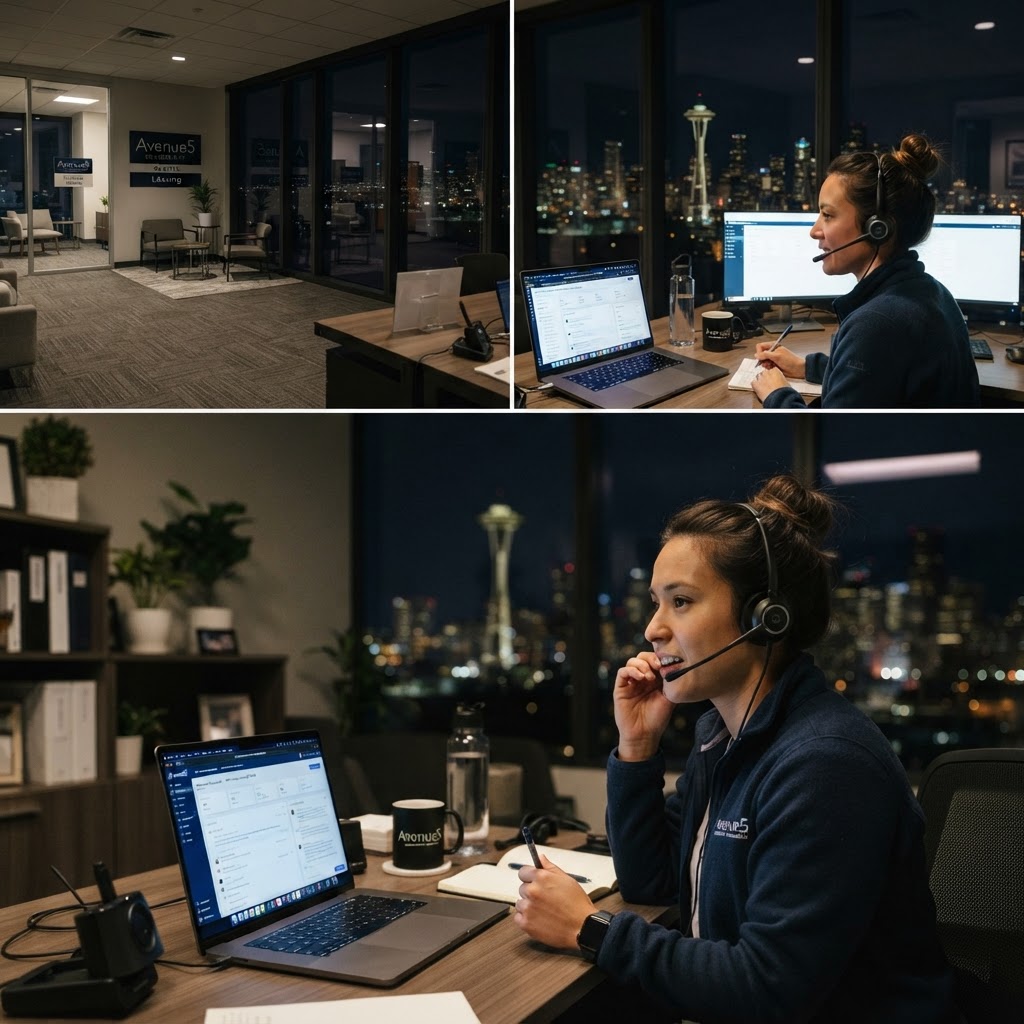
For multifamily property managers across King County—especially enterprise teams like Avenue5 Residential operating in their hometown of Seattle—the local rental environment demands precision. According to recent regional data from Kidder Mathews and Yardi Matrix, Seattle multifamily vacancy sits between 6.7% and 7.2%, with average asking rents hovering around $2,048 to $2,226 per month. While construction completions have tapered compared to previous highs, high-density hubs like South Lake Union, Capitol Hill, and Ballard remain sharply competitive.
Seattle's renter base consists heavily of tech professionals, healthcare workers, and shift-based employees who rarely search for apartments between 9:00 AM and 5:00 PM. Industry research routinely shows that roughly 40% of inbound leasing inquiries occur after hours. In a market where a single signed lease represents upwards of $24,000 to $26,000 in annual gross rent, an unanswered call is not a minor inconvenience—it is an expensive operational leak.
Yet the standard industry response to after-hours traffic has barely changed in a decade. Most properties rely on a stack of lifeless, static tools: robotic phone trees, dead "Contact Us" web forms, and voicemail boxes where prospect intent goes to die. When a software engineer finishes work at 7:30 PM, finds an Avenue5 community online, and dials the leasing office, they are greeted by a generic automated greeting prompting them to leave a message. In that silence, momentum stops. The prospect closes the tab and dials the next mid-rise three blocks away.
Leasing is inherently full of living, active moments. It is an interested prospect asking specific questions about pet policies or parking spot availability at 9:00 PM. It is a live conversation moving fluidly into an appointment, and a ticket transitioning from an incoming inquiry to a confirmed tour the second it happens. The core breakdown for Seattle operators is not an absence of software; it is that conventional property technology never moves on its own.
This is where an AI leasing receptionist changes the equation. Instead of forcing prospects into static intake queues, intelligent voice tools like Lease Tab make the leasing workflow responsive and interactive. When a prospect calls after hours, the AI answers immediately, holds a contextual, natural conversation, provides exact property details, and books a self-guided or in-person tour straight into the team’s PMS calendar. In a city where local ordinances strictly govern fee structures and tenant communications, maintaining automated, accurate, and standardized conversational records is an added compliance benefit.
By handling routine inquiries and calendar management instantaneously, on-site leasing agents walk into the office with pre-qualified, scheduled appointments rather than an inbox full of cold voicemails to triage.
Lease Tab helps Seattle multifamily operators replace dormant lead forms with a responsive leasing presence that stays active 24/7.