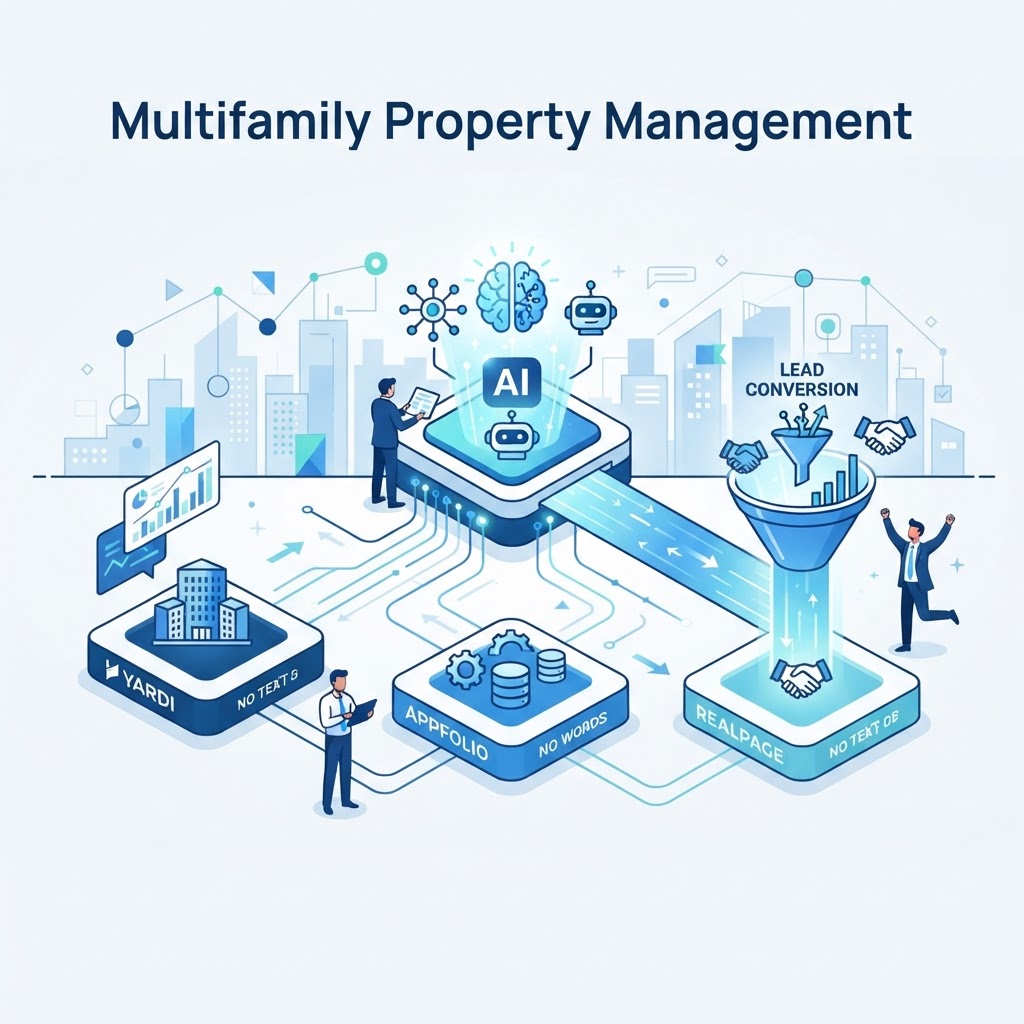
In the current Texas multifamily market, the pressure on operational margins is intensifying. With significant new supply entering metros like Austin and Dallas—where vacancy rates in some submarkets have fluctuated between 7% and 10% over the last year—the cost of a missed lead is no longer a minor annoyance; it is a direct hit to the bottom line.
Most property managers rely on a 'Big Three' system: Yardi, AppFolio, or RealPage. These platforms serve as the essential nervous system for property operations, handling accounting, compliance, and resident portals. However, even the most robust ERP (Enterprise Resource Planning) systems often struggle with the front-end communication gap. While they are excellent at storing data, they are not always designed to engage with it in real-time when a prospect calls at 6:30 PM on a Tuesday.
The Limitations of the Core Stack
Industry data suggests that approximately 40% to 60% of inbound leasing calls go unanswered. In a high-supply environment, a prospect who reaches a voicemail will rarely leave a message; they simply move to the next listing on their screen.
- Yardi and RealPage: These enterprise-grade systems offer incredible depth but can feel cumbersome for on-site staff. The administrative burden of manually logging every interaction often leads to 'data rot,' where the CRM doesn't reflect the true state of the pipeline.
- AppFolio: While praised for its user interface and all-in-one approach, the automation of lead follow-up can sometimes feel rigid, lacking the nuance required to answer specific questions about pet policies or parking availability that drive a tour booking.
The Economic Cost of the 'Busy' Office
If the average customer acquisition cost (CAC) in multifamily ranges from $40 to over $100 per lead when accounting for marketing spend, every missed call is essentially discarded capital. Furthermore, the manual busywork of answering repetitive questions—'Do you have a two-bedroom available?' or 'What are your office hours?'—consumes hours of a leasing agent's week. This is where the integration of specialized AI becomes a necessity rather than a luxury.
Where AI Fits In
The most effective tech stacks in 2024 are moving toward a modular approach. Rather than expecting a single software provider to do everything perfectly, managers are layering specialized AI tools on top of their core systems. An AI leasing receptionist acts as a persistent front-end layer that never sleeps. It can answer specific property questions, pre-qualify leads based on credit and income criteria, and book tours directly into the calendars managed by Yardi or AppFolio.
This shift allows on-site teams to focus on high-value tasks—like closing the lease during an in-person tour—rather than managing the noise of the initial inquiry phase. By automating the top of the funnel, properties can maintain a lower headcount or redirect staff energy toward resident retention, which is increasingly critical as Texas markets become more competitive.
Finding the right balance between your core accounting software and intelligent communication layers ensures that no lead is left behind in a crowded market. Lease Tab provides an intuitive way to capture these opportunities by handling the high-volume inquiries that often slip through the cracks of a busy leasing office.