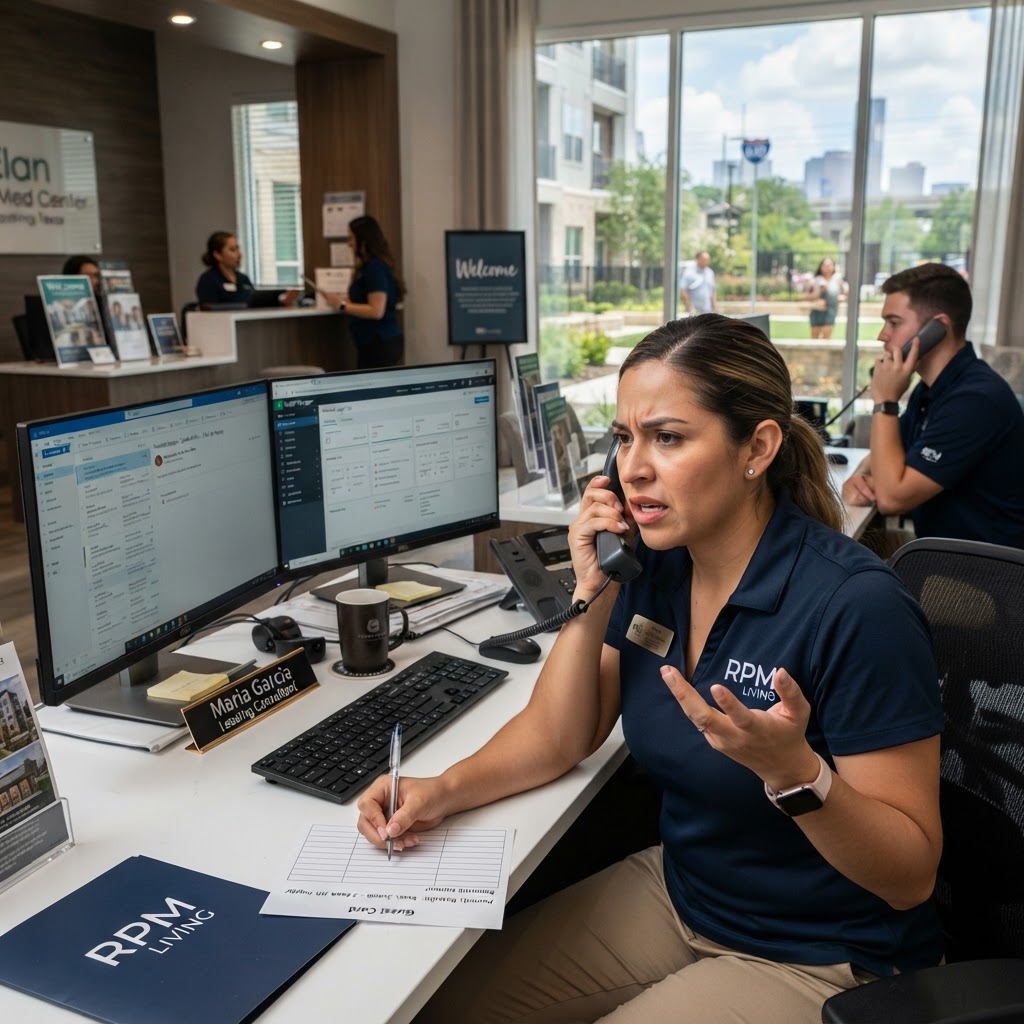
Operating multifamily communities across Greater Houston has always demanded agility, but recent supply waves across the Sun Belt have narrowed the margin for error. Houston delivered more than 25,000 units in a single year, pushing metro vacancy up toward 12.4% while asking rents hovered near $1,400 per unit, according to Matthews Real Estate Investment Services. Whether managing garden-style assets in Katy and Cypress or mid-rises in Montrose, regional operators such as RPM Living face a market where prospective renters have abundant options and minimal patience.
In an oversupplied environment, marketing budgets are spent driving traffic that frequently evaporates at the front door. Multifamily research indicates that anywhere from 49% to over 60% of inbound leasing calls go unanswered, according to data from Digible and Layer3 Labs. When nearly 85% of renters refuse to leave a voicemail and simply contact the next property on their list, every dropped call is a tangible blow to the bottom line. At an average Houston monthly rent of $1,400, a single signed lease represents roughly $16,800 in annual revenue. Letting just three qualified leads slip through the cracks each month can easily translate to over $50,000 in unrealized annual NOI per property.
Yet the fundamental breakdown on-site is not a lack of effort; it is that conventional property management infrastructure is built entirely on lifeless systems. Traditional software stacks leave onsite teams managing static software—dead IVR trees, static web contact forms, unattended inboxes, and neglected voicemails. Meanwhile, real-world leasing is defined by fluid, living events: an energy-sector worker calling at 7:30 PM after a shift in the Energy Corridor, a weekend inquiry looking to tour the next afternoon, or a guest card requiring immediate status progression before interest cools.
When a property’s digital front door is passive, leasing momentum stalls. Speed and consistency dictate leasing velocity. Research highlights that up to 65% of tenant and prospect calls occur outside standard business hours, as noted by Layer3 Labs. Expecting an already stretched onsite team juggling maintenance walk-throughs, audits, and resident renewals to catch every ring is unsustainable.
Addressing this friction requires tools that keep the leasing process alive. Instead of funneling high-intent renters into a silent voicemail queue, conversational AI receptionists interact in real time. They answer immediately, answer hyper-local questions about parking or pet policies, coordinate tour bookings directly on the calendar, and push pipeline records into the CRM the moment the conversation ends. Workflows shift from stagnant queues to active, moving touchpoints.
In a competitive market like Houston, maintaining high occupancy requires leaving behind stagnant contact forms in favor of real-time responsiveness, which is where conversational tools like Lease Tab keep properties moving at the true pace of their renters.